Ever wanted to use the mechanics of an old CD drive for some project?. .
Most CD drives have several motors, of which one has a gear with several cogwheels that can push out the CD-tray and pull it in again.
This is a very useful mechanism in many hobby projects.
The gear looks like this.

The whole CD drive has a lot of electronics and other mechanics, and also uses a lot of current.
There is an eject button connected to those electronics, and a switch that detects when the tray is completely out (end-switch) or in (park-switch).
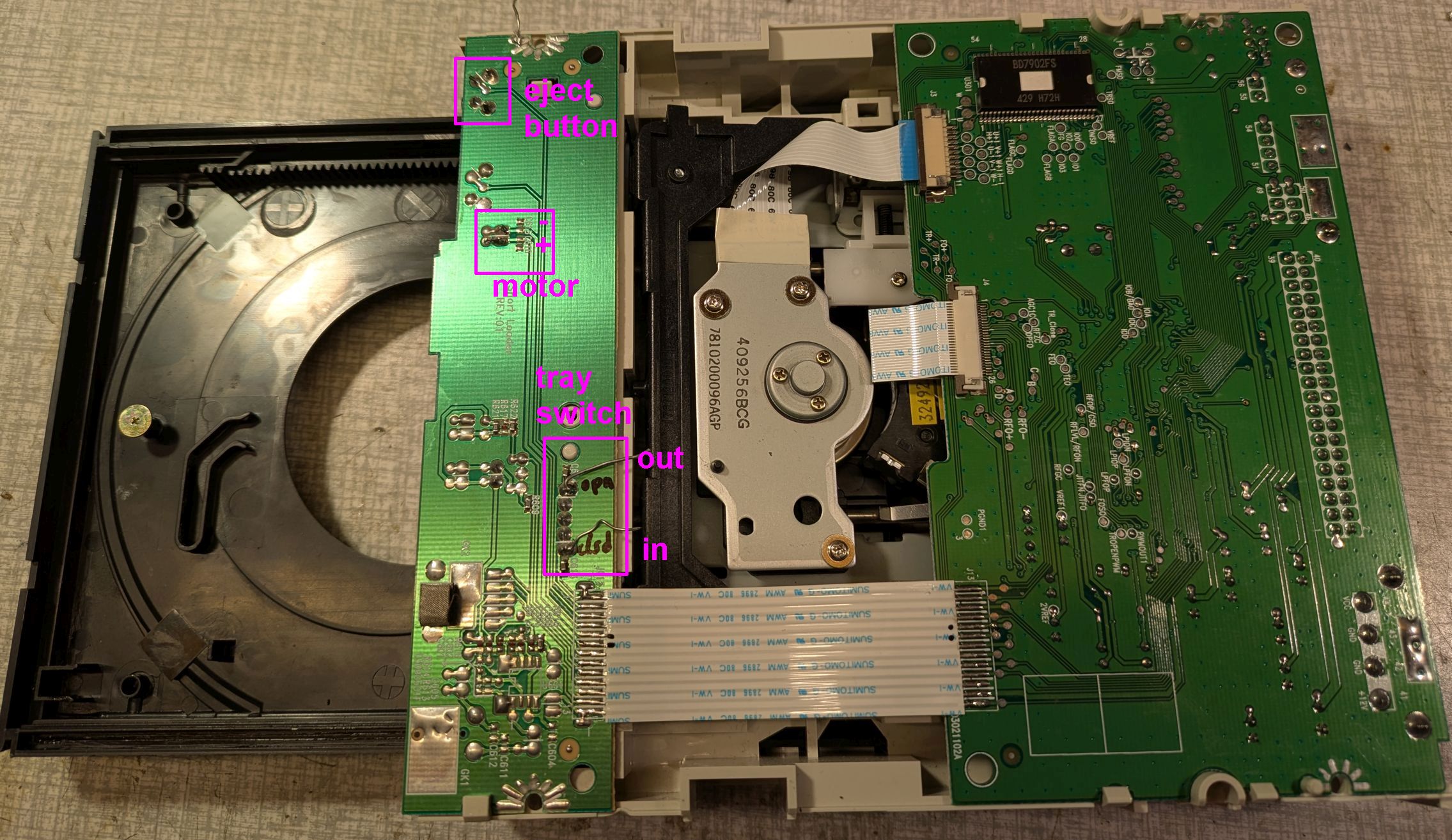
We could just control the eject button, but this has some delay and also why should we not be in total control?
A better way is to just control the tray motor ourselves.
This motor only uses less than 100mA at 5V, whereas the whole CD drive needs both 5V and 12V and uses more than 500mA on each supply voltage.
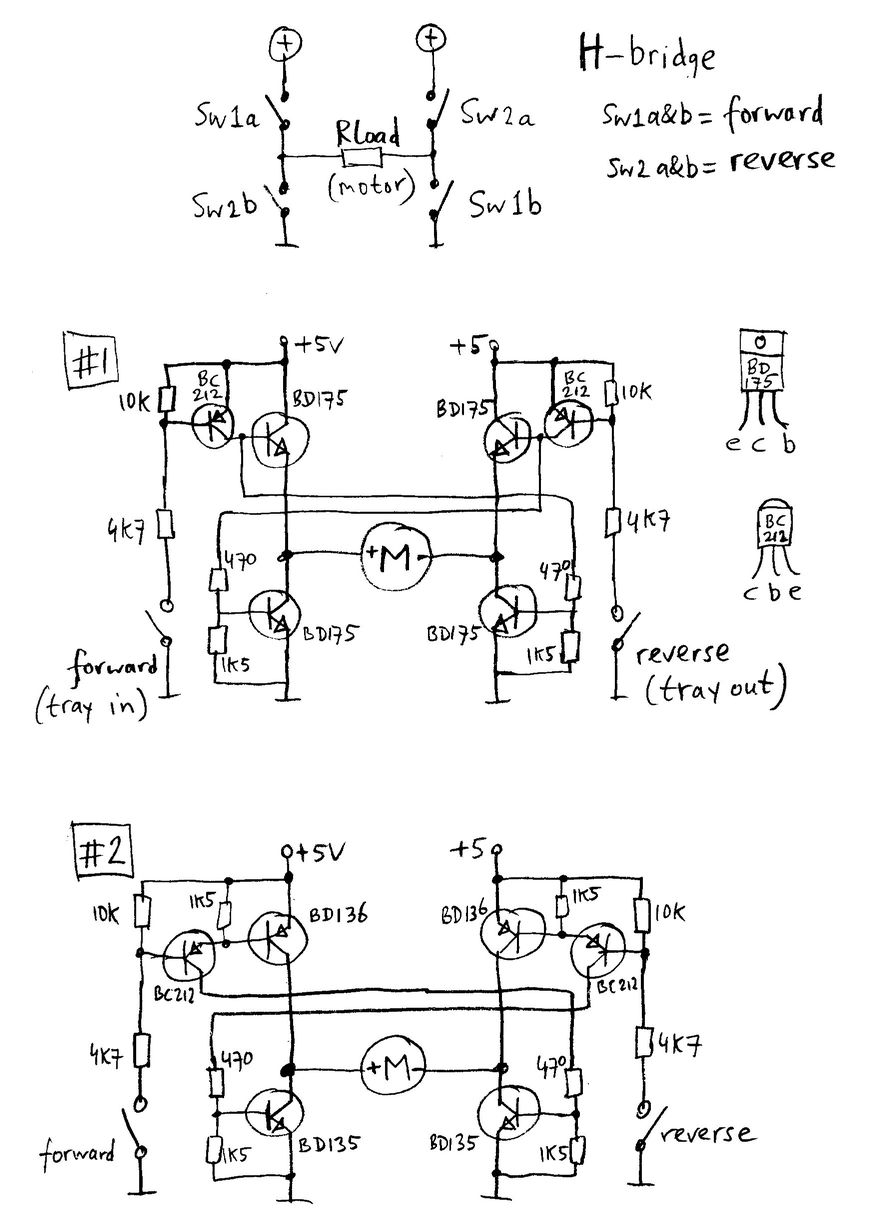
A good way to control a motor is with an H-bridge.
This is basically a set of 4 switches in a H configuration, that can connect the motor to + and ground either way.
The following two diagrams show how to implement it.
#1 is the way I implemented, with NPN power transistors BD175 that I have many of.
This has some base-emitter voltage drop of the upper NPN power transistors, but gives approx 4.2V to the motor, which is more than enough.
#2 is using NPN and PNP power transistors, which avoids the base-emitter voltage drop and thus can give nearly 5V to the motor.
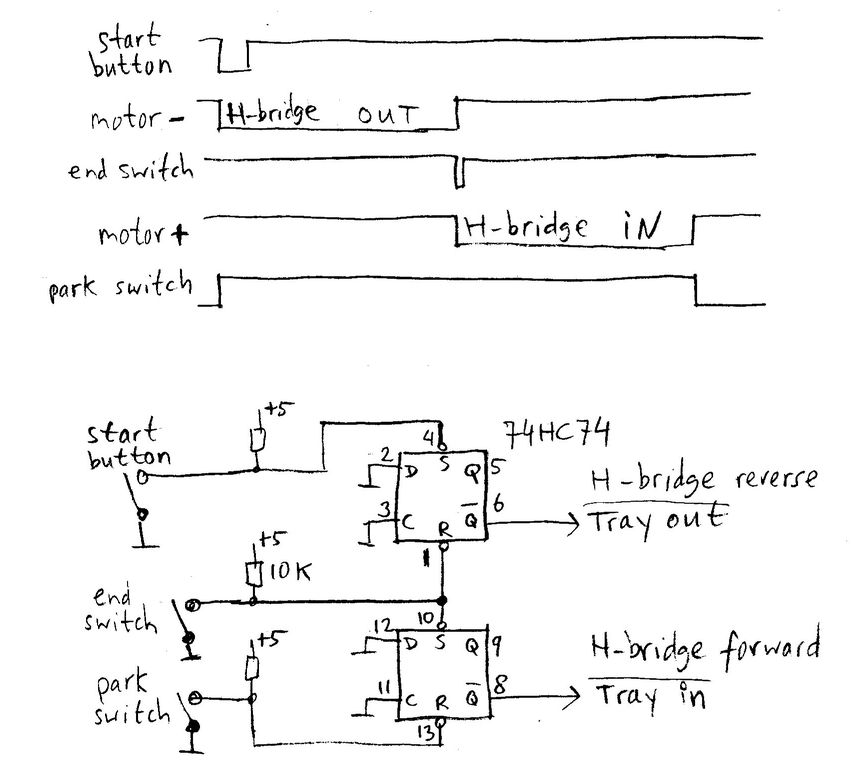
For a drive like this, that has a tray-switch that has two contacts, one that closes when the tray is IN (parked) and another that is closed when the tray is completely OUT, it is easy to make a circuit that can control the tray to go from IN to OUT and then automatically IN again (this is needed for our race-car project, where the tray releases the cars at Start).
When START is activated, the motor has to move in the direction that moves the tray OUT (H-bridge reverse), until the END-switch is activated (tray is OUT).
There the motor must stop and then start in opposite direction to move the tray IN (H-bridge forward), until the tray is totally pulled IN again (parked), where the PARK-switch is activated and the motor stops.
Only 1 chip with 2 flipflops to control the H-bridge is needed to automatically do all this.
Since the switches go to ground, the set and reset inputs have to be active-low.
This is possible with either a 74HC74 or with set/reset flipflops made with NAND-gates like SN74HC00 or CD4011.
We used the following schematic:
this page is made with n073p4d 2